America's home affordability crisis is a maintenance crisis.
Five American crises are arriving at the same address. Maintenance. Construction labor. Insurance. Indoor health. The weight of homeownership itself. One physical site. One affordability problem the country isn't measuring.
- I.The crisis we keep mis-naming
- ·The Cost of Standing · 2000 vs 2024
- II.One crisis, five faces
- ·Capital · Resource · Insurance · Health · Psychology
- III.Five faces, one ledger
The crisis we keep mis-naming.
It's Saturday night. The water heater in the basement starts to fail. It could just as well have been a clogged HVAC drain, a plumbing weep behind a wall, or a roof flashing that aged out unobserved. The pattern is the same. Something fails slowly, in a place no one was looking. By Sunday morning there's an inch of water on the basement floor. The repair that would have run $600 on Tuesday now runs $5,000. Three months later, mold has set into the wall cavity. Nobody opens it until the youngest in the house develops a cough that won't go away. Repeat that across 90 million single-family homes. The part of homeownership everyone argues about (the mortgage, the rate, the listing price) is not the part that has actually moved.
The median American household now spends 45% of gross income on its home. In 2000, that figure was 30%. The mortgage is about a third of the shift. The rest sits in the lines the national affordability conversation never reaches: insurance that re-priced under climate risk, energy bills that drift with the building's condition, and a maintenance burden that has quadrupled as a share of household income. Property tax has roughly doubled too, set locally, debated locally, and absent from any federal frame for what a home costs to stand inside.
Every year, $560 billion goes to American home repairs. Almost all of it reactive. Almost all of it at the worst possible moment. 84% of homeowners say it affects their quality of life. 69% are carrying tasks they keep putting off. 38% call it the single biggest hit to their mental health.
The total annual cost of homeownership rose from 30% to 45% of household income in 24 years. Mortgage explains about a third of the shift. The rest is property tax, insurance, energy, and a maintenance burden that quadrupled.
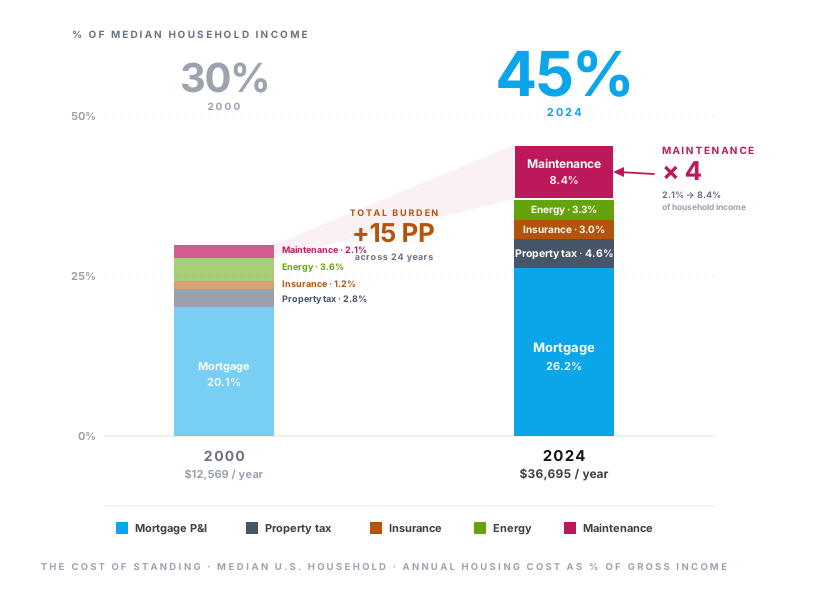
Sources. Census American Housing Survey + 2023 ACS (median home value); Freddie Mac PMMS (mortgage rates); Tax Foundation / ATTOM (effective property tax); NAIC HO-3 (insurance premium); BLS Consumer Expenditure Survey (energy); Harvard JCHS Improving America's Housing 2024 cross-checked against Bank of America Institute (maintenance); Census ACS (median household income). Where ranges exist, headlines bias against the thesis.
The country has been arguing about the wrong thing, and not by accident. 2008 trained a generation of policymakers to see housing as a credit problem. The YIMBY movement gave them the next tractable frame: supply, zoning, permitting. Both have constituencies. Both have federal agencies. The economics of actually owning a home (repair, insurance, energy, the air inside the walls) has neither. A country measures what it has been organized to measure.
None of this argues against the work already underway on supply, zoning, or credit reform. Those efforts are necessary, and they address a different layer of the same problem. This essay is about the layer no one has been counting: the cost of operating the home itself. The housing stock the country already owns is being asked to do more, in worse conditions, with less attention than at any point in its history. That is the problem this essay is trying to make visible.
Underneath all five faces is the same condition. The American home has been quietly packed with complexity: HVAC, electrical, plumbing, the climate envelope, indoor air, water, energy, security. The way the country operates a home has not meaningfully changed in a hundred years. Nobody is in the basement. Nobody is on the roof. Nobody is watching the meter. The crisis the country hasn't been counting is the cost of running the most expensive asset most Americans will ever own with nothing watching it.
Five separate American crises share one physical site. Maintenance. Labor. Insurance. Indoor health. The weight of homeownership itself. They all arrive at the largest asset most families will ever own, and the most expensive thing they have ever been able to ignore.
One crisis, five faces.
The capital trap.
The homeowner's balance sheet has quietly become a deferred-emergency ledger.
The unplanned cost of keeping a home running is prohibitive for the median household. HVAC, water heater, roof, repipe: any one of these runs $5,000 to $15,000. Several come due in any decade. Of homeowners with outstanding maintenance tasks, 45% estimate the total cost would top $5,000. 15% say $20,000 or more. Most don't have that capital on hand, so they defer. Then the deferred damage compounds. A missed $400 HVAC tune-up becomes a $12,000 compressor replacement on a 110-degree day.
The shape of this on the ground is specific. Last year I rode along with Mitch, a senior technician at a leading home services company. We pulled the side panel of a furnace and found the heat exchanger cracked at the seam. The kind of failure that shows up in a carbon-monoxide alarm before it shows up as a loss of heat. This one already had. The homeowner had been on a paid maintenance plan for years, doing everything she had been told to do. Months earlier her sump pump had failed and flooded the basement. She was still paying down the home-equity loan she took to fix it. Monitoring wouldn't have saved the pump (pumps wear out), but it would have caught the failure weeks early, before it became an emergency. She sat at the kitchen table in tears, unable to afford the new furnace and unwilling to leave her family in a house that was, in her words, putting her family's life at risk. The replacement ran $8,000. She could only afford it because the company carries financing in-house. The trade itself is now the only working consumer-credit channel at the American kitchen table.
The household most exposed is the one with the most wealth locked inside it. Roughly 70% of homeowners over fifty intend to age in place. Home equity is, for most of them, the largest asset they will ever hold. They are also the least able to inspect a crawl space, climb onto a roof, or reach the panel in the basement. The visibility problem is most acute where the capital is most concentrated. A generation is being asked to underwrite its retirement out of an asset it can no longer observe.
The resource ceiling.
The standard answer is to build more housing. The industry that would do the building cannot.
The skilled trades (HVAC, plumbing, electrical) have been in chronic shortage for a decade, and the gap is widening. The Associated Builders and Contractors put the construction industry's annual shortfall near half a million workers. The gap has not closed in the postwar record. It is driven mostly by retirements, not by growth.
The trades are not an abstract labor supply. They are roughly 700,000 American small businesses, mostly family-owned, mostly under fifty employees. They are the front line of the maintenance economy. They are caught inside the same closed system: rising materials costs they can't fully pass through, a hiring problem the BLS numbers describe but don't solve, and customers who defer because they can't afford not to. The people who would build the answer are themselves being asked to absorb the problem.
Materials can't price their way out: the Producer Price Index for construction inputs sits 30% to 60% above its 2019 baseline. The grid can't generate its way out: NERC has flagged five-to-ten-year reliability risk across most of the continental U.S. Much of the load driving that risk is residential. Peak summer HVAC demand from oversized, chronically inefficient home systems is a substantial share of the worst hours of the year across most U.S. grids. The grid is straining, in part, to feed inefficiency no one is watching. Water in the Southwest is constrained: the Colorado River compact allocates more water than the river now carries. Land in every productive metro is contested.
The country can't build its way out with the labor, materials, and infrastructure it has. It will not acquire them in usable quantity within the relevant timescale. The American home is now operating inside a closed system, the way the planet does. The way we have run homes for forty years assumed open inputs that no longer exist.
In a closed system, supply comes from preservation as much as construction. Every existing home kept in service is a home that doesn't need to be built. Labor not spent on a prematurely failed system is labor for a new build. Capital not spent on the bill that came due at the worst moment is capital for the next mortgage. The fastest, largest, most readily available source of new housing supply in America is not new construction. It is the housing we already have, kept standing on purpose instead of by accident.
The insurance unraveling.
A house that can't be insured can't be mortgaged. A house that can't be mortgaged can't be sold.
The story isn't California wildfires anymore. The new center of the insurance unraveling is the severe-convective- storm corridor that runs from Texas through Oklahoma, Iowa, and the upper Midwest. NOAA counted 28 separate billion-dollar weather disasters in 2023, the highest on record. 2024 cleared 27. Hail-and-tornado losses have, in several recent years, exceeded hurricane losses as the largest source of insured natural-catastrophe damage in the country. Premiums are up 20% to 40% in most markets over three years. In the most exposed, 60%. Non-renewal concentrates in the regions two generations of Americans were specifically told to retire to.
Uninsurable becomes unmortgageable becomes unsellable. That is the sentence carriers are now writing into the social contract under American homeownership.
Carriers don't have a path out of this through pricing. They have one through prevention. The first signs are visible: a handful of carriers piloting premium discounts for households with continuous water-leak detection, smoke and CO monitoring, and freeze sensors. Reinsurers are pushing in the same direction faster. Within a decade, basic home monitoring will sit alongside the deadbolt and the smoke alarm as a baseline expectation of an insurable home. The carriers that get there first will write the rule everyone else has to follow.
The health burden in the walls.
Indoor air is the only major environmental input modern American life does not continuously manage.
Every major environmental surface a household touches is observed in some continuous way. Every one except the one where Americans spend 90% of their lives. The EPA has reported, consistently for thirty years, that indoor air is two to five times more polluted than outdoor air. Asthma alone now costs the United States $81.9 billion a year, much of it traceable to indoor conditions. Radon kills about 21,000 Americans every year. One in fifteen homes carries elevated levels. Lead-paint hazards remain in 24 million housing units. Falls inside the home cost the healthcare system $50 billion annually. Mold (the most commonly experienced of these hazards) follows almost every undetected water event, which is itself the most common deferred-maintenance failure in the American home. The CDC and EPA increasingly link prolonged exposure to respiratory illness and a documented set of cognitive and neurological effects.
The psychological tax.
The home was supposed to be the foundation. It has become the destabilizer.
A water leak goes unobserved. Mold colonizes the cavity behind it. Someone in the family develops a respiratory condition. Medical costs compound with the original repair bill. The household defers the next maintenance event. The financial pressure and the illness together deepen the cognitive load. One household, all five faces, in a single year.
Every other consumer category in the American economy has moved households up the pyramid for thirty years. Housing has done the opposite. It has pulled them back toward the base.
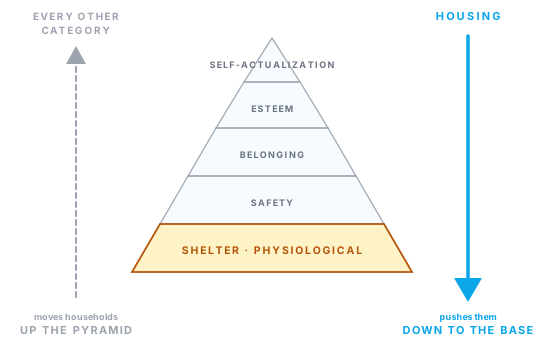
Maslow's hierarchy placed shelter at the base of the pyramid: the foundation on which everything else rested. Once the base was secure, the household could attend to belonging, esteem, self-actualization. For most of the twentieth century, the American home was the recovery surface from the rest of life. That direction of travel has reversed.
The cognitive cost of running a house under chronic financial pressure is not a metaphor. Mani, Mullainathan, and colleagues' scarcity research found that unresolved financial stress imposes cognitive deficits on the order of 13 IQ points, comparable to losing a full night of sleep as a sustained background condition. Berman and Kaplan's attention-restoration work established that the indoor environment most Americans inhabit 90% of the time is now actively depleting rather than restorative. 20.7 million American homeowner households now cross the federal threshold of housing cost burden, the highest figure since 2011, before any of the burdens of this essay are counted. The deed no longer confers calm. It confers a recurring sense that something expensive is about to break.
The inversion is not evenly distributed. It is amplified, sharply, by income. The household that can absorb a $12,000 emergency without flinching experiences the home as a minor irritation. The household for which the same $12,000 forces a choice between the HVAC and the credit card experiences it as an existential threat. They live the rest of the year carrying the residual cognitive load of knowing the next $12,000 is coming. A schoolteacher in Phoenix opens the breaker panel at eleven o'clock on a 110-degree night and weighs the credit card against her children's bedrooms. The Maslow inversion is, in this sense, an inequality multiplier. The country's wealthiest experience modern American homeownership as inconvenience. Its working middle experiences it as siege. In 2024, home projects emerged as the single most stressful budget category for U.S. homeowners, ranking ahead of healthcare, childcare, debt, education, and entertainment.
And it arrives at a moment when peace of mind inside the home matters more, not less, than at any point in living memory. The post-pandemic loneliness epidemic. The cratering of in-person third places. The migration of work into the residence. The adolescent mental-health crisis. Each has raised the home's importance as a restorative environment to a point where it can no longer afford to be the source of the depletion. Every other consumer category in the American economy has spent three decades moving the household upward, toward connection, expression, self-realization. Housing has done the opposite. It has pulled an entire generation back toward the base of the pyramid it was supposed to anchor.
Capital scarcity, the resource ceiling, the insurance unraveling, the indoor-air epidemic, and the psychological tax do not compete for attention. They compound at the same physical site.
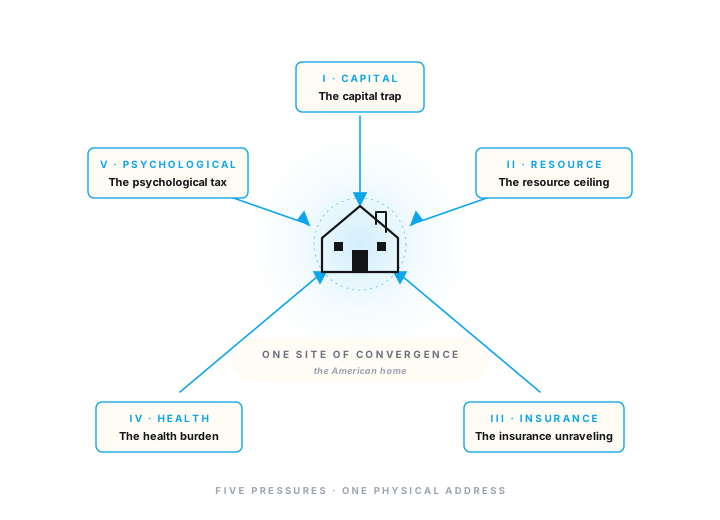
Five faces, one ledger.
Capital scarcity forces deferral. Deferral feeds waste. Waste raises the energy and insurance bills. Rising insurance feeds scarcity. Scarcity makes the labor constraint bite harder. Emergency pricing degrades indoor conditions. Degraded conditions raise healthcare costs. Healthcare costs erode household resilience. Eroded resilience makes deferral more likely. Each loop tightens the others. Each year, faster.
“Five separate American crises. One address.
The insurance market can't underwrite its way out of climate risk. The healthcare system can't treat its way out of the indoor-air epidemic. The homeowner can't pay their way out of monthly compounding deferred maintenance. Considered at the single physical site where they all arrive, they describe the biggest hidden affordability problem in the American economy.
The household ledger has a national twin. Americans now spend more than a trillion dollars a year on the homes they already own. $560 billion on repairs and services. $280 billion on energy. $180 billion on insurance. $100 billion on appliances and durable goods. By a conservative reading, anchored by the three-to-five-times preventive-vs-emergency multiplier visible on any service truck, a third of that, three hundred billion dollars a year, is avoidable. Emergency repairs that would have been routine if anyone had been watching. Premiums that re-priced after losses monitoring would have caught. Energy that leaks because no one sees it leaking. Products that fail because they are running outside the envelope they were designed for.
Three hundred billion dollars is the cost of a million and a half new American homes every year, in perpetuity. It is more than the federal government spends on housing, surface transportation, and the EPA combined. We are paying, year after year, the cost of repairing our past instead of investing in our future. The same dollars, redirected, are the largest available source of new American housing supply this decade.
The American home is infrastructure. We have not yet treated it as such. The country has, in living memory, modernized other infrastructure of comparable scale: the interstate, the grid, the water system, the air-traffic network. Each received the observability, the maintenance regime, and the public attention proportional to its importance. The home, which holds the majority of American household wealth and is the converging site of every crisis in this essay, has received none of those things. It is asked to do more than it was designed for, in conditions it was not built for, and it is asked to do so silently. The basic infrastructure of observation and stewardship the rest of the modern economy has built for itself does not yet exist for the American house. The country has done this before, when it chose to see the system whole.
There is precedent. In 1971, a pediatrician named Herbert Needleman began measuring lead in the baby teeth of Boston children. Over the following decade, against resistance at every step from the lead-paint and leaded-gasoline industries, he established a dose-response relationship between household lead exposure and cognitive deficit. The lead had been in the walls of nearly every American house built before the late 1970s. It was the largest environmental exposure of the postwar period. Invisible to the families exposed. Defended by interests that profited from its non-recognition. The accounting always arrives late, and never voluntarily. The indoor environment of the American home, in 2026, is sitting at the same point on the same curve.
The recognition is the prerequisite. What follows (how the housing stock starts taking care of itself, who is already building the infrastructure that would make it possible, the unfair advantage of doing this work from inside the trades rather than above them) is the subject of a coming essay.
This one is to make the shape of the problem unforgivably clear.
Alexander Linn is the founder and CEO of Shipshape. Shipshape partners with home-services operators across the country on the monitoring and stewardship that catch failures before they become emergencies. For correspondence: alexander@shipshape.ai.
Continue from here
Index of long-form pieces on housing cost after the mortgage.
How monitoring turns deferred maintenance into managed cost.
Articles, whitepapers, and guides for homeowners and pros.
Where the numbers came from.
Every figure traces to a public dataset, federal survey, or peer-reviewed source. Where ranges exist, headlines bias against the thesis.
- Joint Center for Housing Studies, Harvard · State of the Nation's Housing (2024)
- Harvard JCHS · Improving America's Housing (2024)
- American Housing Survey · U.S. Census Bureau
- HUD housing-cost-burden definitions
- Bank of America Institute consumer data
- Tax Foundation / ATTOM · effective property-tax rates
- Freddie Mac PMMS · mortgage rates
- BLS Occupational Employment Statistics
- Associated Builders & Contractors · construction-labor analyses
- BLS Consumer Expenditure Survey · energy spend
- BLS Producer Price Index · construction inputs
- North American Electric Reliability Corporation · long-term reliability assessments
- NOAA NCEI · billion-dollar disaster ledger
- NAIC HO-3 · Homeowners Owner-Occupied report
- California Department of Insurance · market filings (State Farm, Allstate, 2023)
- Citizens Property Insurance Corporation, Florida
- EPA · indoor air quality & radon assessments
- CDC · asthma and fall-injury cost analyses
- Mani, Mullainathan et al. · Science, 2013 · scarcity research
- Berman & Kaplan · attention-restoration research
- AARP · aging-in-place survey work